Supported operating systems
Experimental. exo-v2v 0.1.0 is an early release, validated in one lab (ESXi 7.0 U3 to Exoscale ch-gva-2). Try it on non-critical VMs first; commands and behaviour may change.
exo-v2v converts guests with
virt-v2v-in-place, so it
can migrate the guests virt-v2v supports. The tables below separate what we
tested end to end from what we expect to work.
Tested
Each guest below was migrated live from ESXi 7.0 Update 3 to Exoscale (zone ch-gva-2) while running, with a system disk and a separate data disk. After each migration we compared marker files on both disks with their checksums from the VMware build, and checked the boot, the network, the mounted data disk and the services.
| Operating system | BIOS | UEFI | Data disk | Downtime |
|---|---|---|---|---|
| Ubuntu 24.04 LTS | Yes | Yes | Not checked: the test image's data disk was blank | 2–3 min |
| Debian 13 | Yes | Yes | ext4 | 4–5 min |
| AlmaLinux 9.8, SELinux enforcing | Yes | Yes | XFS created with 512-byte sectors (rebuilt for 4 KiB sectors at cutover) | 5–7 min |
| Windows Server 2022 | Yes | Yes | NTFS (adapted to 4 KiB sectors in place) | 5–8 min |
| Windows Server 2025 | Yes | Yes | NTFS (adapted to 4 KiB sectors in place) | 6–9 min |
The downtime column covers every run. The chart shows the final run of each guest through a receiver template:
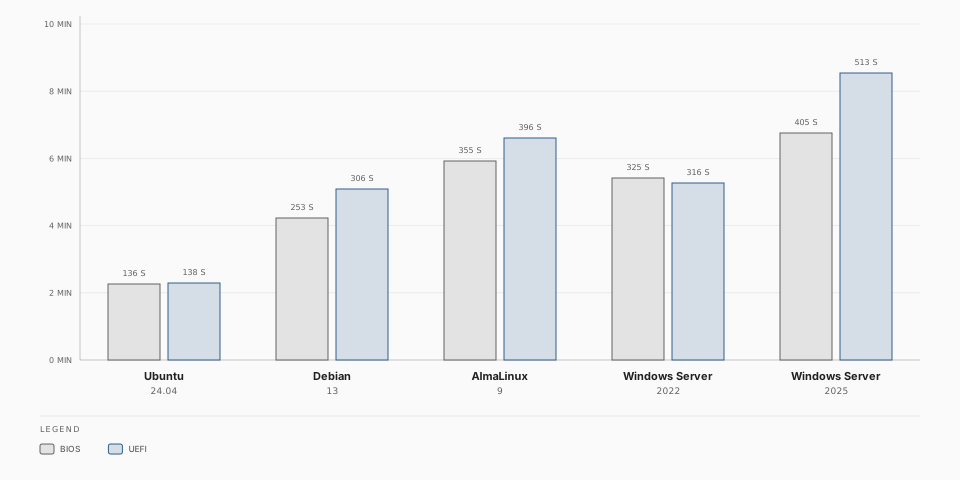
Ubuntu 24.04 and Windows Server 2022 were also migrated from UEFI with Secure Boot on: both booted on Exoscale with Secure Boot on (downtime 133 s and 455 s).
A Debian 13 VM under continuous write load was also migrated with a downtime of 5 minutes and no lost writes. Up to 8 migrations ran at the same time from one replication appliance. Every guest above was migrated with a receiver template; all except Windows Server 2025 also without one.
Expected to work
These are supported by virt-v2v and use the same mechanisms as the tested guests, but we have not migrated them in our lab. Migrate a non-critical VM first.
| Family | Versions |
|---|---|
| Red Hat Enterprise Linux and rebuilds (Rocky Linux, AlmaLinux, Oracle Linux, CentOS Stream) | 8, 9, 10 |
| Debian | 11, 12 |
| Ubuntu LTS | 20.04, 22.04 |
| SUSE Linux Enterprise Server, openSUSE Leap | 15 |
| Windows Server | 2016, 2019 |
Older releases (for example RHEL 7 or Windows Server 2012 R2) may convert but are out of their vendors' support; we do not recommend them.
Not supported
| Case | Why |
|---|---|
| Windows client editions (Windows 10, 11) | Not tested; out of scope for this release |
| Encrypted system disks (LUKS, BitLocker) | The conversion has to read and modify the guest's system disk |
| Operating systems other than Linux and Windows (FreeBSD, Solaris, …) | virt-v2v does not convert them |
| 32-bit guests | Not tested; Exoscale instances are 64-bit |
| VMs with more than 6 disks, independent disks or raw device mappings | See Limitations |
Windows licensing
A migrated Windows Server runs on an instance created from a Linux template, unless its receiver template is a Windows-licensed one published by Exoscale (not available yet, see Receiver templates). Contact Exoscale before migrating Windows workloads to agree on licensing.